

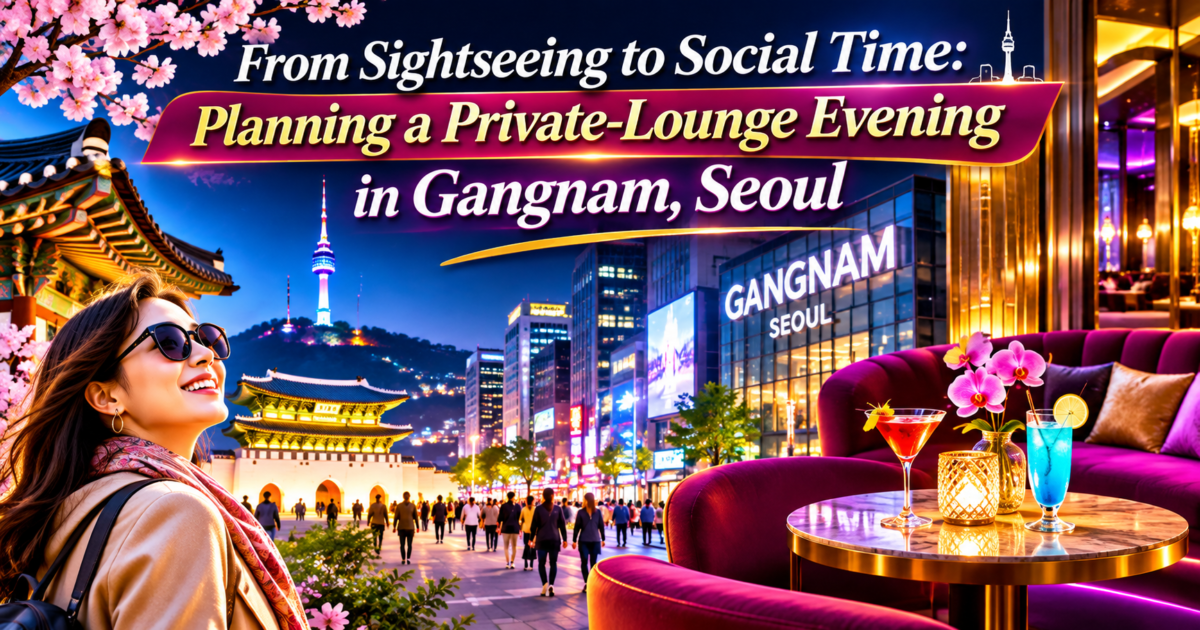
From Sightseeing to Social Time: Planning a Private-Lounge Evening in Gangnam, Seoul
An evening abroad often starts with a simple question: where should we go after dinner? The answer becomes more complicated when a group wants different things. One person imagines music and a lively crowd. Another hopes for a comfortable seat and a conversation that does not involve shouting. Someone else wants to experience a setting they would not normally encounter at home. A satisfying plan begins by making those expectations visible before anyone books a table or orders a drink.
Gangnam, a district of Seoul in South Korea, offers a useful setting for thinking about these choices. Its name may already be familiar to international visitors, but familiarity with a name is not the same as understanding a local venue. In particular, a private lounge should not automatically be pictured as a hotel lounge, an ordinary walk-in cocktail bar, or a public dance floor. The format, admission arrangements, services, and costs need to be understood individually.
Begin with the kind of evening you actually want
Rather than collecting a long list of fashionable addresses, describe the evening in ordinary language. Is the priority conversation among adult friends, a small celebration, or simply exploring a different side of the city? How long does everyone want to stay? Does the group want alcoholic drinks, and is anybody uncomfortable with an adult nightlife setting? These are practical questions, not obstacles to having a good time.
Agreement matters more than a polished photograph. A room can look impressive while being unsuitable for the people using it. Equally, an understated setting may suit a relaxed group better than somewhere designed around spectacle. Everyone should understand the nature of the venue and feel free to choose a different plan. Private-room nightlife is one possible leisure activity, not an essential part of visiting South Korea.
Understand what a private setting changes
In a public bar, you can often assess the mood from the doorway. You may see the seating, hear the music, and read a menu before deciding to stay. A room-based lounge can require more preparation because those details are less immediately visible. The room itself, the arrival procedure, and the service arrangement become important parts of the experience.
The Korean-language guide 일프로 provides one example of how information about this format is presented locally. It brings together photographs and publicly available details for ten private lounges in Gangnam. Its listings are arranged alphabetically in Korean rather than as a recommendation ranking. For an international reader, that distinction is useful: a position on a page does not establish that a venue is better, more popular, or more suitable than another.
Treat the guide as a starting point for questions rather than a substitute for direct confirmation. Private lounges belong to an adult nightlife context; they should not be assumed to offer the same experience as family karaoke rooms or a hotel meeting space. Ask what the service includes, which arrangements are optional, and what rules apply to your visit. A clear answer is more valuable than an attractive label.
Read a photograph for practical clues
Travel photographs encourage us to imagine ourselves in a place. For an evening venue, however, the most useful details can be surprisingly ordinary. Look at how chairs are arranged. Can the whole group sit together? Is there a table suitable for the way you intend to spend the evening? Does the visible layout suggest easy conversation, or is the room arranged mainly around entertainment equipment?
A photograph cannot answer every question. It does not demonstrate current availability, actual sound insulation, or the condition of a specific room on a specific evening. A wide-angle image may make a space seem larger than it feels in person. Ask for the room arrangement that would apply to your group, and check whether the image represents that room or simply illustrates the venue generally.
Numbers also need context. The number of rooms in a building is different from the number of seats in one room. A listing that mentions seventeen rooms does not promise space for seventeen people together. Give the organizer your actual group size and ask for a specific answer about seating and room allocation.
Make the route part of the plan
Gangnam is a district, not one meeting point. Choosing somewhere merely because it is described as being in Gangnam can still leave your group with an awkward journey after dinner. Start with the location of your meal or accommodation, then compare the addresses of the evening options. Avoid estimating a journey solely from how close two names appear on a list.
Save the Korean address as well as the venue name. An English transliteration may be useful in conversation, while the original address can be easier to show a driver or compare with a map. If an entrance is on a side street or inside a building, ask for arrival instructions before setting out. Share those instructions with everyone, particularly if people are arriving separately.
Plan the journey back at the same time. Check transport information for your actual date and intended departure time. If the group plans to drink, arrange a suitable ride instead of relying on somebody to drive. Keeping enough money for the return journey also prevents the end of the evening from becoming an avoidable source of stress.
Compare complete arrangements, not isolated prices
A quoted drink price is not necessarily a complete estimate for a private-room evening. Before comparing venues, keep the basic conditions consistent: the same number of guests, the same intended duration, and a comparable selection of drinks. Otherwise, two prices may describe substantially different experiences.
Ask whether the quotation includes room charges, service charges, taxes, and any minimum spend. Clarify what happens if you stay longer, add another person, or change the order. If a deposit is required, obtain the cancellation and refund conditions before paying it. Request a written explanation in language you can understand, and keep it available during the visit.
For a shared outing, agree how the bill will be divided before arriving. People may have different budgets or drink different amounts. A short conversation beforehand is kinder than a difficult discussion at the end. The aim is not to account for every moment of enjoyment; it is to let everyone relax without uncertainty about an obligation they did not intend to accept.
Use local information without overreading it
The practical value of a local guide lies in the questions it helps you formulate. On gangnamilpro.com, location filters and a shortlist function help visitors collect lounge options and organize inquiries under comparable conditions. Saving a candidate is not a confirmed reservation. The site also distinguishes its shared inquiry contact from the individual venues’ direct telephone numbers.
That separation is worth remembering when using any intermediary. Identify who is answering your question, who will confirm the reservation, and who is responsible for the final arrangements. Published descriptions and opening hours can change. Missing information should be treated as a question to ask, rather than proof that a facility is either available or unavailable.
Translation tools can help with an initial reading, but short, concrete questions usually travel across languages better than elaborate requests. State the date, group size, expected arrival time, and the issue you need clarified. Ask for an explanation if an unfamiliar term remains unclear. There is no need to pretend that you understand a local expression simply to avoid an awkward moment.
Leave room for a different ending
A well-planned evening still needs flexibility. If the available room, costs, or service format do not suit your group, another bar, a meal, or an early return to your accommodation can be the better choice. Travel becomes less enjoyable when every researched idea turns into an obligation.
The most rewarding part of exploring an unfamiliar city is not ticking off a supposedly exclusive experience. It is making informed choices that suit the people sharing the trip. In Gangnam, as elsewhere, understanding the setting, respecting personal preferences, and confirming practical details can turn a vague idea for the evening into a comfortable plan. Those habits leave more attention for the conversation and company that made going out worthwhile in the first place.
Author note: This article is a planning guide based on publicly available venue information. It is not a firsthand review, a ranking, or a guarantee of any venue’s services or availability.


